
SAP IBP Heuristic vs Optimizer: Why Defaulting to Heuristic Is Costing Your Supply Chain
Fast planning isn’t smart planning. It’s one of those lessons every supply chain team eventually learns — usually the hard way, in the middle of a constrained quarter when a key distribution center stocks out while another sits on excess inventory.
One of the most common worst practices we see in SAP IBP implementations is the default reliance on the Heuristic engine in highly constrained, multi-node scenarios — simply because it runs fast and feels familiar. The cost of that habit shows up later: missed service levels, working capital tied up in the wrong nodes, and planners losing trust in the system.
Why the SAP IBP Heuristic Engine Falls Short Under Constraints
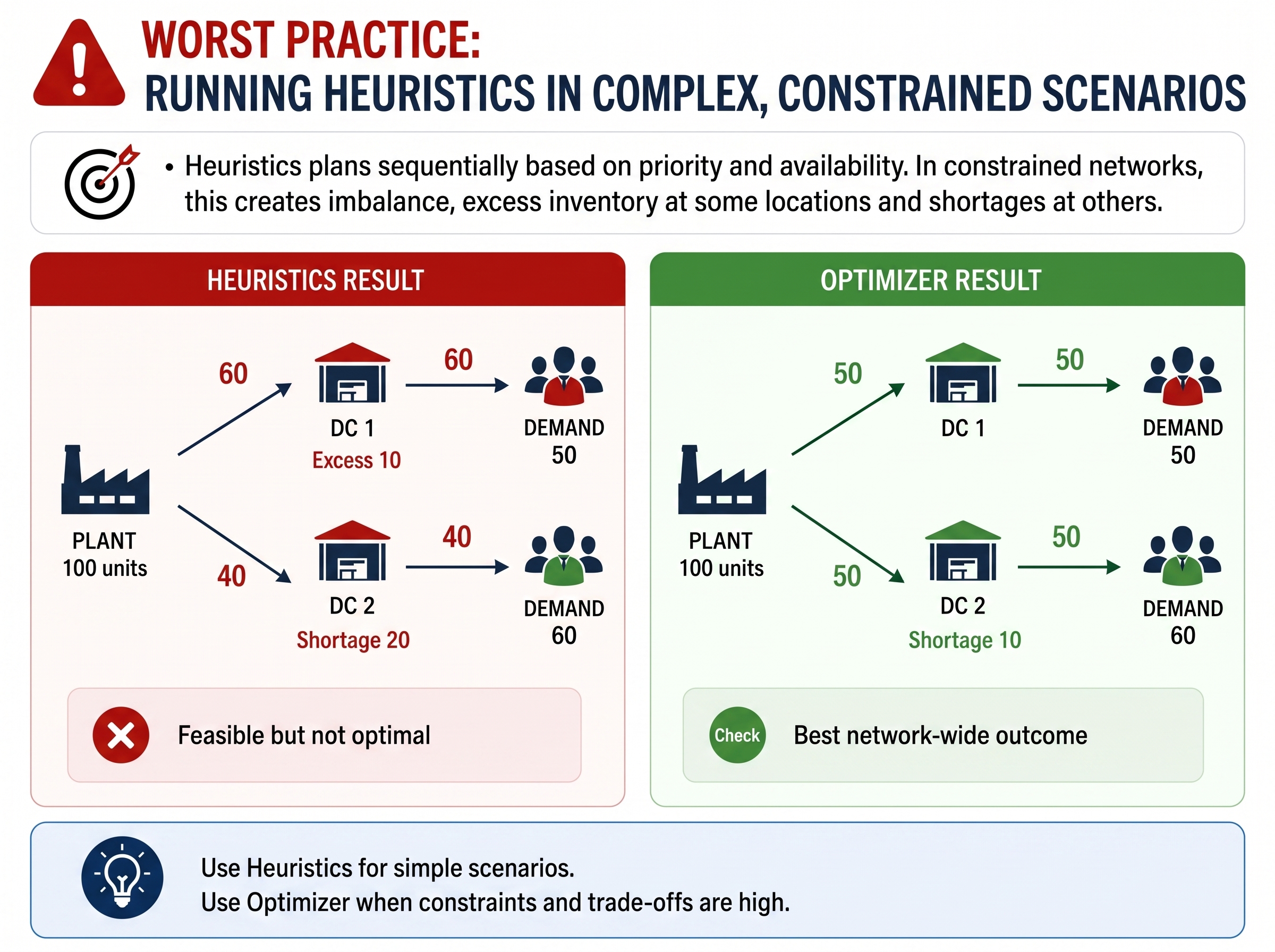
The Heuristic engine in SAP IBP plans sequentially. It serves the highest-priority demand first, moves to the next, and continues down the list. It’s fast, produces a feasible plan, and on paper everything looks fine.
The problem surfaces when supply is constrained across multiple DCs or plants. Because Heuristic doesn’t evaluate the network as a whole, it can leave one node bloated with inventory while another faces a stockout for the same SKU. Technically feasible. Operationally costly.
Where the SAP IBP Optimizer Engine Delivers Real Value
The Optimizer takes a fundamentally different approach. It evaluates the entire supply network simultaneously — constraints, trade-offs, costs, priorities, sourcing logic, and capacity — and solves for the best overall outcome.
Yes, it takes longer to run. But the output is genuinely optimal, not just feasible. For organizations dealing with multi-sourcing decisions, tight capacity, or competing priorities across regions, that difference translates directly into service level improvements and reduced inventory carrying cost.
The Real Worst Practice: Using One Engine for Everything
Heuristic isn’t bad. Optimizer isn’t a silver bullet. The actual worst practice is treating either as the universal answer.
Here’s a practical framework for choosing the right SAP IBP supply planning engine:
Use the Heuristic Engine When:
- Scenarios are unconstrained or only lightly constrained
- You need what-if speed for quick iterations
- Sourcing logic is simple and sequential
- Planners need fast feedback during interactive sessions
Use the Optimizer Engine When:
- Capacity constraints are tight across the network
- You face multi-echelon trade-offs across DCs and plants
- Cost-driven decisions matter (transportation, production, holding)
- Multiple sourcing options and competing priorities are in play
The Question Mature Planners Ask
The mature planner’s question isn’t “which engine is better?” — it’s “which engine fits this scenario?” That single shift in mindset, embedded into your S&OP cadence and planner training, is often the difference between an SAP IBP implementation that delivers ROI and one that quietly underperforms.
Fast planning isn’t smart planning. Choose the engine your business problem actually deserves.
Is Your Team Defaulting to Heuristic Out of Habit?
If your supply planners are reaching for the Heuristic engine on every run — regardless of constraint complexity — there’s a strong chance you’re leaving service level and inventory savings on the table.
Read our related posts:
https://demandplanning.net/causal-event-forecasting-vs-smoothing-sap-ibp/
https://demandplanning.net/sap-ibp-equal-split-forecast-disaggregation/